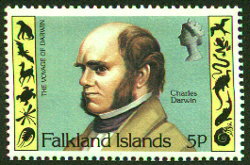
A brief look at two of Darwin's microscopes

by David Walker


The author is an amateur naturalist not a historian, and these notes are only intended to give a flavour of some aspects of this topic using the listed references as a basis. These references can provide more detailed information.


Charles Darwin's well known works were concerned primarily with organisms that were far from microscopic but he did own and use microscopes. Some of his lesser known works e.g. on Cirripedes (barnacles), insectivorous plants and the fertilization of orchids were based to a greater or lesser extent on his microscopical observations.

Brief notes on two of Darwin's microscopes are below.


The Microscope taken on HMS Beagle

Before Darwin set out on the now famous Beagle voyage in December 1831, he sought the advice of Robert Brown regarding a suitable microscope to take with him. Robert Brown was a pioneering botanist and microscopist who is perhaps best remembered for first describing the random motion of colloidal particles now named after him - Brownian motion. Brown had sailed as a naturalist aboard the Investigator which surveyed the northern and southern coasts of Australia in 1801.

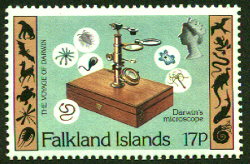
On the advice of Brown, Darwin only took with him a simple microscope on the Beagle. This microscope is shown on the stamp on the right and was made by Bancks and Son.

Robert Bancks (or Banks) was an instrument maker to George IV, and had also made instruments for scientists such as Robert Brown. The description 'simple microscope' refers to the single lens construction rather than to its capabilities; simple microscopes could be used for serious research work.


Darwin's Compound Microscope

By the middle of the nineteenth century, the achromatic compound microscope had been developed to a stage where the optics were superior to that of a simple microscope.

 In 1846 Darwin bought a compound microscope because of his need for higher magnifications (shown left).

 It is signed on the foot of the microscope 'Jas SMITH LONDON'. This microscope has many of the features typical of a compound microscope of the time, and which are recognizable in today's models i.e. coarse and fine focusing, mechanical stage and provision for substage condenser. The fine focusing was achieved by turning the milled screw in front of the nosepiece.


Why not find out more about Darwin and his work by visiting Darwin's home, now a museum at Down House, Downe, Kent, UK. The English Heritage web site can provide up to date visitor information.


References and sources of information

The author's casual interest in Darwin's microscopes was inspired by reference 1, and visits to Downe House, Kent and to the Whipple Museum, Cambridge. The above notes include facts from ref. 1 and 2. However, any errrors in the notes above are those of the author David Walker.

The photograph of the compound microscope above was taken by the author at the excellent special exhibition 'The Social History of the Microscope' held in 1986 at the Whipple Museum of the History of Science, Cambridge, UK.

1) W A S Burnett and L V Martin, Microscopy, 1992, vol. 36, part 8, 604-627.
An excellent article which discusses Darwin's microscopes in some detail. Microscopy is the Journal of the Quekett Microscopical Club.

The Quekett Microscopical Club Journal 'Microscopy' regularly has authoritative articles on all aspects of the history of light microscopy and microscopists.

2) Single Lens: The Story of the Simple Microscope by B J Ford, Heinemann, London, 1985. 182 pages. SBN 434 26844 5.
An easy to read but authoritative account of the contribution Anton van Leeuwenhoek and others made to science using a single lens microscope. Some aspects of Darwin and his microscopes are covered in this book.

3) Collecting Microscopes by G L'E Turner, Christie's International Collectors Series, Mayflower Books, New York 1981. 120 pages. ISBN 0 8317 5950 X.
A beautifully illustrated book written by one of the foremost authorities on the history of the microscope.

4) The Microscope Past and Present by S Bradbury, Pergamon Press, London, 1968. 272 pages. Library of Congress Catalogue Card No. 68-24061.
A fascinating and scholarly account of the history and development of the microscope.

5) Some lesser known publications by Charles Darwin.

 A Monograph on the Subclass 'Cirripedia' 2 vol. 1851-54 (reissued as vol 11-13 of The Works of Charles Darwin 1988).

 On the Various Contrivances by Which British and Foreign Orchids are Fertilised by Insects... 1862.

 Insectivorous Plants 1865.

 The Different Forms of Flowers on Plants of the Same Species 1877.


Microscopy UK Front Page
Micscape Magazine
Article Library


© Microscopy UK or their contributors.

Please report any Web problems or offer general comments to the Micscape Editor,
via the contact on current Micscape Index.

Micscape is the on-line monthly magazine of the Microscopy UK web
site at Microscopy-UK


© Onview.net Ltd, Microscopy-UK, and all contributors 1995 onwards. All rights reserved. Main site is at www.microscopy-uk.org.uk with full mirror at www.microscopy-uk.net.

Brunel Microscopes for student microscopes, stereo microscopes, low cost microscopes, microscope resources, microscope accessories, second hand microscopes, and  microscope cost comparisons.